Natural Water Sources Explained, From Rivers to Rainwater
Jerome StolzNatural water sources can come from very different places, and each source comes with different risks. River water, for example, can be exposed to animal waste or runoff, while rainwater can collect contaminants from the air. Melted snow and spring water have their own risks as well.
So, how can you drink from natural water sources safely? This guide looks at five common types, the risks associated with each, and the steps that can make the water safer to drink.
What Counts as a Natural Water Source?
A natural water source is any water that collects, flows or falls without being treated by anyone. Common natural water sources include rivers, streams, lakes, ponds, springs, snow, glacier melt, and rainwater.
There are three main categories of natural water sources:
-
Surface water: Surface water includes rivers, streams, lakes, and ponds. Because it collects at the surface, it can be exposed to wildlife, human activity, soil, and surface runoff.
-
Groundwater: Groundwater is water stored beneath the ground in soil and rock. It can reach the surface naturally through springs, and the surrounding soil and rock may provide some filtration. However, this does not mean spring water is automatically safe to drink.
-
Precipitation: Precipitation includes rain and snow that forms in the atmosphere before reaching the ground. As it falls and collects, it can pick up contaminants from the air, surfaces, soil, vegetation, animals, and other sources.
Are Natural Water Sources Safe to Drink?
Natural water sources should generally be treated before drinking, as they can contain microorganisms that aren’t visible to the naked eye.
The risk depends largely on what enters the water and the surrounding watershed. For example, wildlife, livestock, and human waste can introduce pathogens such as Giardia, Cryptosporidium, Campylobacter, and certain strains of E. coli into natural water. This is why water that looks clear or has no unpleasant smell is not necessarily safe to drink.
If you drink contaminated water, you might not notice anything wrong straight away. Some waterborne infections take days or even weeks to cause symptoms, which can make it hard to know where you picked up the infection.
The safest approach is simple: treat natural water before drinking it, regardless of how clean the source looks.
Five Natural Water Sources and Their Risks
Natural water sources can have different contamination risks, so it’s important to consider both the type of source and its surroundings. No natural source should be assumed safe to drink without appropriate treatment.
| Water source | Common risks | What to check | Practical takeaway |
|---|---|---|---|
| Rivers and streams | Wildlife, livestock, and waste from camps upstream | Look upstream for camps, livestock, or well-used animal trails | Moving water still carries whatever entered it higher up, so treat what you scoop |
| Lakes and ponds | Still water, algae and cyanobacteria blooms, and whatever washes in off the banks | Avoid visible algal blooms, scum, or discolored water, and heavy animal activity near the shore | Still water holds on to what gets in, so treat it and draw from the cleanest spot you can find |
| Springs | Animal and human activity around the spring, and minerals and other contaminants carried in the groundwater | Check that the water surfaces straight from rock or ground, not a shallow pool or seep | Groundwater may be naturally filtered, but it can still contain contaminants. Treat it before drinking |
| Snow and glacier melt | Airborne particles the snow collects on the way down, and fine glacial grit (rock flour) in the melt | For snow, check whether the snow looks clean. For glacier melt, look at how much sediment it carries | Snow can contain contaminants, while meltwater may carry sediment. Let the sediment settle, then treat the water before drinking |
| Rainwater | Rain can pick up particles in the air, then dirt and animal droppings from the surfaces it lands on. | Consider the collection surface, storage container, and surrounding environment | Rain can be relatively clean at collection, but it can become contaminated after contact with surfaces |
1. Rivers and Streams
If you’re collecting water from a river or stream, make sure to pay attention to your surroundings. Look for a collection point upstream of any obvious contamination. If possible, collect water from the cleanest area you can reach.
Avoid stagnant pools or areas where debris or sediment has collected. If possible, collect from moving water rather than directly from the riverbank, where runoff can enter the stream.
Remember: Flowing water can be a good natural source, but appearance and flow are not reliable indicators of safety. Treat river and stream water before drinking it.
2. Lakes and Ponds
Lakes and ponds can be affected by cyanobacterial blooms, which may produce toxins that are harmful to people. These toxins may be present in the water even when they cannot be seen.
This means that removing microorganisms alone may not be enough to make the water safe to drink. Ordinary filters are designed to remove particles and microorganisms, so they may not remove cyanobacterial toxins. Boiling is not a reliable way to make water containing these toxins safe either.
If you notice a visible bloom or scum on the water, avoid collecting it. If a lake or pond is your only available source, treat the water before drinking it and avoid areas showing signs of a bloom.
3. Springs
A spring forms when groundwater reaches the surface through soil or rock. As groundwater moves through these materials, some contaminants may be filtered out, which can leave spring water looking clear.
However, that does not mean the water is safe to drink. Groundwater can contain dissolved minerals and other contaminants, while activity around the spring can introduce microorganisms. Livestock, wildlife, runoff, and human activity can all affect the water.
When assessing a spring, look for water that emerges directly from the ground or rock rather than a shallow pool or muddy seep. Check the surrounding area for signs of animals, waste, or other contamination.
Even a protected-looking spring should be treated before drinking. The US National Park Service advises visitors not to drink untreated water from natural sources such as springs, streams, and lakes.
Bottom line: Springs can look clean and may benefit from natural filtration, but the water should still be treated before drinking.
4. Snow and Glacier Melt
Snow may look clean, but it can pick up particles and pollutants from the air as it falls. Research from Finland found that snowfall can remove airborne particles from the atmosphere more efficiently than rain. Once snow is on the ground, its condition and surroundings can also affect the quality of the water it produces when melted.
Glacier melt has a different concern, which is sediment. The milky or cloudy appearance of glacial meltwater often comes from rock flour, fine particles of rock ground down by moving ice and carried away in the meltwater. Let the sediment settle before filtering the water to reduce the amount of material your filter has to handle.
Melting snow also takes extra fuel and time, so if you're in winter or alpine conditions, plan your water supply before relying on snow as your main source.
5. Rainwater
Rainwater can be relatively clean when collected directly, but its quality depends on the surrounding environment and the surface it touches.
As rain falls, it can pick up particles and microorganisms from the atmosphere. Once it reaches a surface such as a roof or a rock, it can also pick up bird droppings, dirt, chemicals, and other contaminants.
If you collect rainwater while hiking, use a clean container or collection surface whenever possible. Avoid water that has already run across visibly dirty surfaces or areas contaminated by animals.
Rainwater can be a useful supplement when conditions allow, but it should not automatically be considered safe to drink untreated. The CDC recommends treating collected rainwater before drinking it.
How to Choose a Safe Water Source in the Wild
Here are some practical factors to consider before collecting water from different sources in the wild:
1. Check What Is Upstream
Before collecting water, check the area upstream of your collection point. If you have more than one option, choose the source with the clearest conditions and the least activity nearby.
2. Avoid Visible Signs of Contamination
Skip any water source with obvious signs that something is wrong, such as heavy algae, surface scum, unusual discolouration, strong odours, or visible waste. If possible, choose another source rather than relying on extra filtration to make visibly affected water safe.
3. Consider What Treatment You Can Use
The water source you choose should also match the treatment method you have available. Different methods are designed to address different types of contaminants, so check what your filter or purifier has been tested to reduce.
If you know there is a specific contamination risk in the area, make sure your treatment method is designed for it.
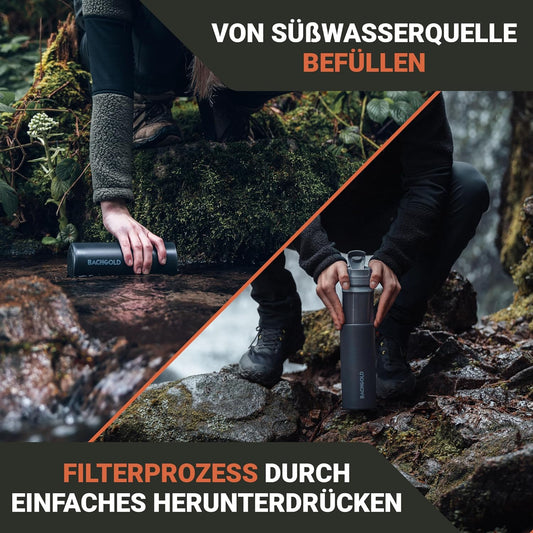
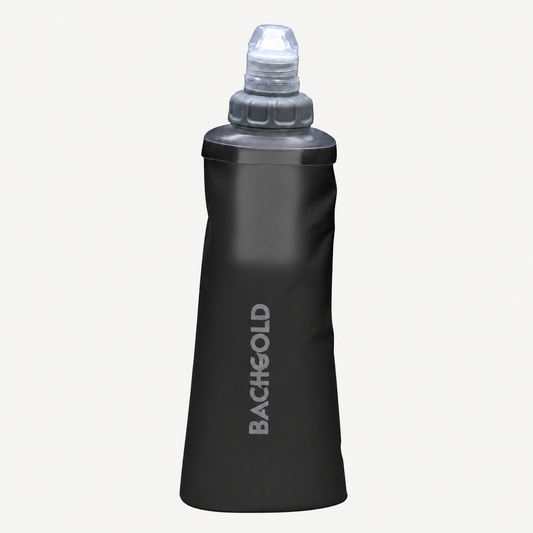
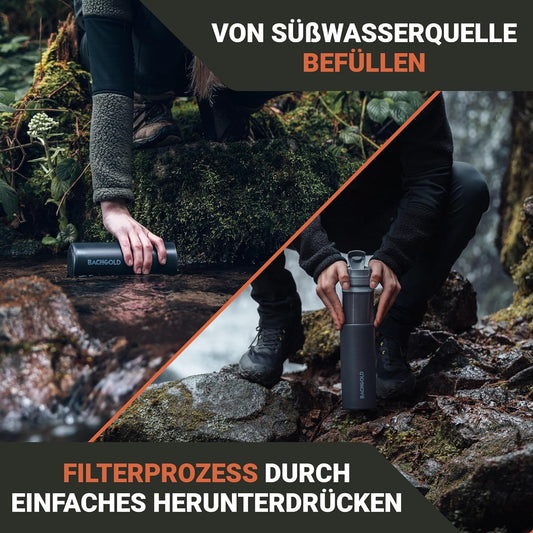
BACHGOLD offers filters with different microbiological performance characteristics. Our BACHGOLD Self Press can reduce bacteria and protozoa, while our Squeeze and Straw provides virus reduction. Check the available laboratory testing information to understand exactly what has been evaluated.
Key takeaway
Choose the cleanest-looking source with the fewest contamination risks upstream, then use a treatment method appropriate for the water and contaminants you may encounter. No natural water source should be considered safe to drink simply because it looks clear.
How to Treat Water From Any Natural Source
Natural water should be treated before drinking. Several treatment options are available, including filtration and boiling.
Hollow-fibre filtration works well for many natural freshwater sources by trapping microorganisms and particles through microscopic pores. Depending on the filter's pore size and tested performance, it may reduce bacteria, protozoa, and other particles without chemicals or batteries. Check the manufacturer's testing to confirm which contaminants a specific filter is designed to remove.
Silty or heavily cloudy water can affect filtration, so follow the manufacturer's instructions for pre-treatment, cleaning and backflushing. These steps can help maintain the filter's performance.
Boiling is another effective treatment option. The CDC recommends bringing water to a rolling boil for one minute to kill bacteria, viruses and parasites, or for three minutes at elevations above roughly 2,000 metres. Boiling does not remove chemical contaminants, heavy metals or salt, so the choice of water source still matters.
Drink From Whatever You Find
Choosing a natural water source is only the first step. Pay attention to the conditions around the source, avoid obvious signs of contamination, and use a treatment method suited to the water and the equipment you have with you.
For hikers and trekkers, carrying a reliable filtration system can make treating suitable natural freshwater sources simpler. BACHGOLD filters are designed to reduce bacteria and protozoa without chemicals or batteries, offering a lightweight option for treating water along the trail.
There is also a wider reason to carry a BACHGOLD filter. Part of every purchase supports the Viva con Agua Nepal drinking-water project, helping support access to clean drinking water beyond the trail. Explore the full range and choose a filter for your next hike or trek.
Frequently Asked Questions
Which Natural Water Source Is Safest to Drink From? +
Can I Drink Water Straight From a Mountain Stream? +
Is Melted Snow Safe to Drink? +
Can I Drink Rainwater I Collect on a Hike? +
References
The following sources were used to research this article.
- Centers for Disease Control and Prevention. About Water Treatment Options When Hiking, Camping, or Traveling. US CDC, 2024. https://www.cdc.gov/drinking-water/prevention/water-treatment-hiking-camping-traveling.html
- Pires SM, Fischer-Walker CL, Lanata CF, Devleesschauwer B, Hall AJ, Kirk MD, et al. Aetiology-Specific Estimates of the Global and Regional Incidence and Mortality of Diarrhoeal Diseases Commonly Transmitted through Food. PLOS ONE, 2015; 10(12): e0142927. https://doi.org/10.1371/journal.pone.0142927
- US Environmental Protection Agency. Revised Total Coliform Rule State Implementation Guidance. EPA 816-R-20-003, 2020. https://www.epa.gov/sites/default/files/2015-10/documents/rtcrimplementation_guidance.pdf
- US Environmental Protection Agency. Surface Water Treatment Rules. US EPA. https://www.epa.gov/dwreginfo/surface-water-treatment-rules