You can drink from a contaminated stream during a hike and feel completely fine for days. But some of the nastier waterborne bugs take one to three weeks to show up, so by the time the cramps start, you're usually back home blaming something you ate. The time gap between drinking and getting sick is what makes untreated water so easy to underestimate.
This is why most hikers and backpackers treat their water before drinking it. A hollow fibre filter is the common choice. It's light, it's fast, and it works the moment you collect water from the source.
This guide covers what a hollow fibre filter removes, what it doesn't, how it works, and when a purifier is the better option.
Why Most Backpacking Water Filters Use Hollow Fibre Technology
Most backpacking filters use hollow fibre for a simple reason. It does more things well than the alternatives. Chemical drops leave you waiting for the disinfectant to work.
UV pens depend on batteries or a charge, which can fail in the cold. Many pump filters are heavier, with more parts that can clog or break. Hollow fibre avoids all of these problems.
The filtration is purely mechanical, so nothing is added to your water, and no power source is needed. The filter is light and lasts a long time before it needs replacing
For most trips across Europe, North America, Australia, and New Zealand, the main biological risks in freshwater are bacteria and protozoa. Hollow fibre removes both, which is why it's the default choice for hikers and travellers heading into those regions.
What Does a Hollow Fibre Water Filter Remove?
A hollow fibre filter is built to catch the living things and loose particles you find in untreated freshwater. These are the threats you're most likely to meet in a stream, river, or lake.
-
Bacteria such as E. coli, Salmonella, and Campylobacter
-
Protozoa such as Giardia and Cryptosporidium
-
Sediment and suspended particles
-
Turbidity, the cloudiness in water
-
Many microplastics
This matters because Giardia and Cryptosporidium are among the most important waterborne pathogens in untreated surface water, according to the U.S. Environmental Protection Agency's Surface Water Treatment Rules, with similar findings from the Centers for Disease Control and Prevention through its waterborne disease surveillance. Cryptosporidium is the harder of the two to deal with. It resists chlorine, but a physical filter still removes it.
The filter does this with microscopic pores small enough to block bacteria, protozoa, and sediment while letting water through.
What Doesn't a Hollow Fibre Water Filter Remove?
A hollow fibre filter does a great job on bacteria, protozoa, sediment, and many microplastics. What it can't catch is viruses. Viruses are much smaller than bacteria, small enough to slip straight through the filter. The common waterborne ones are Norovirus, Rotavirus, and Hepatitis A.
For most people drinking from remote mountain streams, this isn't a big concern. In Europe, North America, Australia, and New Zealand, bacteria and protozoa are the real risks. Viruses mainly become a problem where water mixes with sewage, poor sanitation, or a lot of people.
A standard hollow fibre filter also does not remove:
-
PFAS (per- and polyfluoroalkyl substances)
-
Heavy metals such as lead and arsenic
-
Nitrates
-
Dissolved salts
-
Industrial pollutants
-
Agricultural chemicals and pesticides
These are dissolved right down to the molecular level, far too small for any filter to catch. Removing them takes special treatment like activated carbon, ion exchange, or reverse osmosis, which is what the World Health Organization recommends for contaminants like lead, arsenic, and nitrate. The EU Drinking Water Directive sets strict legal limits on these same contaminants, including PFAS.
On most hikes, these chemicals aren't your main concern. But if your water sits near industry, mining, farm runoff, or wastewater, don't count on a filter. Find a cleaner source instead. The simple rule is this: A hollow fibre filter protects you from the living threats in wild water, not from chemical pollution.
How Does a Hollow Fibre Water Filter Work?
A hollow fibre water filter works by physically separating contaminants from water. Inside the filter are thousands of tiny hollow tubes, often compared to microscopic drinking straws. The walls of these fibres are lined with microscopic pores.
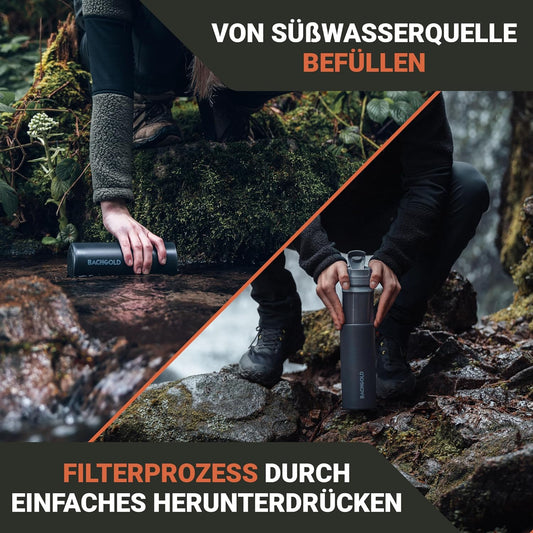
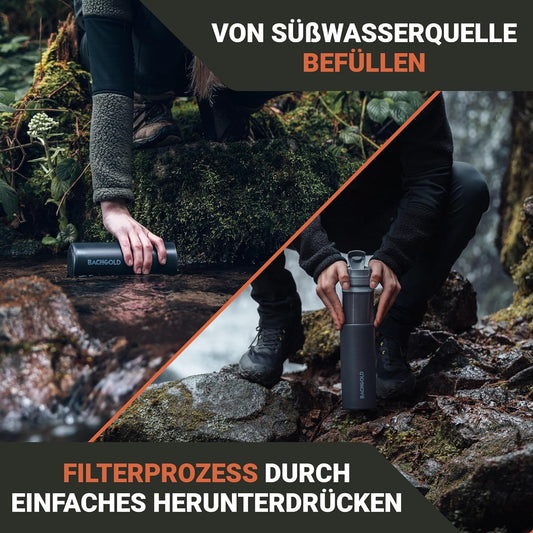
When you push water through, by squeezing, pressing, pumping, or just letting gravity do the work, the water slips through while anything bigger gets caught on the outside. Bacteria, protozoa, sediment, and many microplastics are all too large to pass, so they stay behind and never reach your bottle.
This process is known as mechanical filtration. No chemicals are added, no electricity is required, and there is no waiting period before drinking.
Why Independent Testing Matters
Not every filter is tested the same way, and some aren't really tested at all. That's worth knowing before you trust one with your drinking water. One of the most respected benchmarks in the outdoor world is NSF P231, a standard for microbiological water purifiers. To pass, a filter has to prove it removes microorganisms under controlled lab conditions.
Performance is measured in LOG reduction, the internationally recognised way to quantify how many microorganisms a filter removes, with each step up the scale removing ten times more.
Independent testing under NSF P231 documents performance across the filter's full rated life rather than relying on a stated pore size, which is a manufacturer specification that doesn't capture real-world performance on its own.
When Do You Need a Water Purifier Instead?
A water purifier becomes important when viruses are a real risk. That mostly means travel through Southeast Asia, South Asia, Central and South America, and parts of Africa, along with anywhere water is affected by sewage or flooding. Viruses like Norovirus and Hepatitis A are much smaller than bacteria and pass straight through standard hollow fibre filters.
This is usually where a filter needs backup, such as UV treatment, chlorine dioxide, or a virus-rated purifier. The Bachgold® Squeeze and straw filter are an exception. Both are highly effective against viruses, so in many higher-risk places, they cover the gap a standard filter leaves.
Hollow Fibre vs Other Water Treatment Methods
| Treatment Method |
Bacteria |
Protozoa |
Viruses |
Sediment |
Chemicals & Pesticides |
Heavy Metals |
Power Needed |
| Hollow Fibre Filter |
Removes |
Removes |
Reduces |
Removes |
No |
No |
No |
| Activated Carbon |
No |
No |
No |
No |
Reduces |
Reduces some |
No |
| UV Purifier |
Deactivates |
Deactivates |
Deactivates |
No |
No |
No |
Yes |
| Chemical Treatment |
Effective |
Limited* |
Effective |
No |
No |
No |
No |
| Boiling |
Kills |
Kills |
Kills |
No |
No |
No |
Fuel needed |
*Chemical treatments like chlorine are less effective against Cryptosporidium, which resists chlorine.
For most outdoor use, hollow fibre is the lightest and most practical option.
How to Care for Your Hollow Fibre Filter
A hollow fibre filter needs a bit of care, mostly after your trip rather than during it. A few simple habits keep it flowing fast and filtering properly for as long as possible.
-
Pre-filter silty water: let sediment settle, or strain the water through a cloth first, so grit doesn't clog the membrane.
-
Dry it before storing: don't leave it sitting wet for weeks between trips.
-
Watch its lifespan: replace the filter once it reaches the end of its rated life.
-
Never let it freeze: the one mistake you can't undo.
That last point deserves its own warning. When water left inside the filter freezes, it expands and can crack the hollow fibres from the inside. You won't see the damage. The filter may still pass water while no longer trapping anything dangerous.
Finding the Right Hollow Fibre Filter for Your Needs
Once you know what a hollow fibre filter handles and what it doesn't, choosing one stops feeling like guesswork. You know it clears the bacteria and protozoa waiting in that stream, and you know when a trip calls for something more.
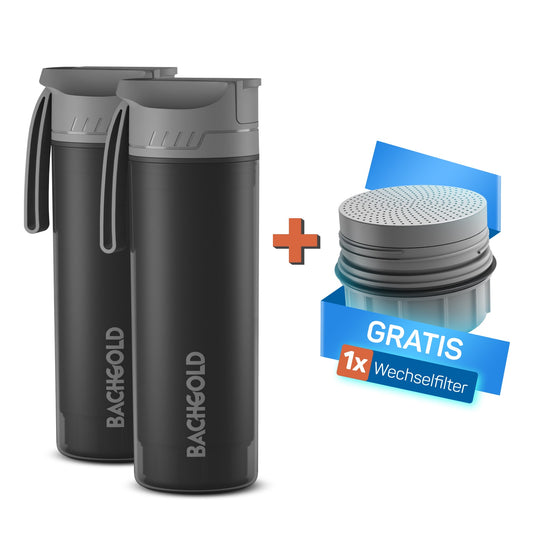
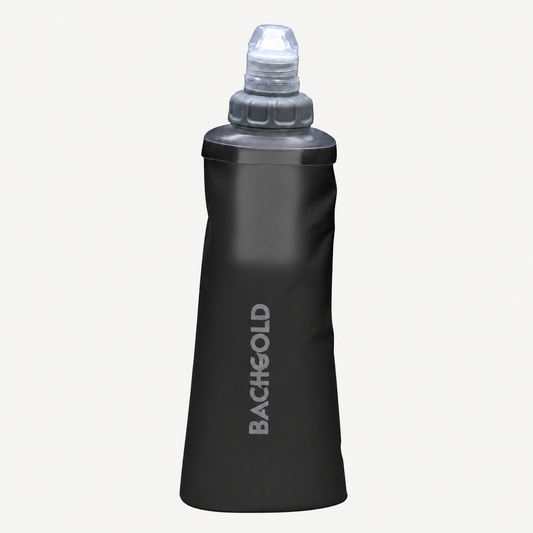
Bachgold® filters remove bacteria and protozoa, and the Squeeze and straw filter are highly effective against viruses, too. No chemicals, no batteries, and nothing to wait for before you drink. Part of every purchase goes into the Viva con Agua Nepal drinking-water project for the same reason, and the full range is on the product page.
Shop the Bachgold® filter today