Do Water Filters Remove Microplastics? What Actually Works (2026)
Jerome StolzYou have probably heard the headlines about microplastics turning up in tap water, bottled water, and even human blood. It's enough to make you look at your next glass of water a little differently. If you already use a water filter, you may be wondering whether it actually removes microplastics.
The short answer is yes. Many water filters do remove microplastics, but not all perform equally well. In general, filters with the right filtration technology, such as hollow fibre filters, and a sufficiently small pore size capture more of these tiny plastic particles.
This guide explains what microplastics are, how they get into drinking water, what current research says about their potential health effects, and which filtration technologies are most effective at reducing them.
What Are Microplastics and Nanoplastics?

Microplastics are plastic particles smaller than 5 millimetres, while nanoplastics are typically smaller than 1 micrometre (1 µm). For comparison, a human hair is about 70 µm wide. That means most microplastics are much thinner than a hair, while nanoplastics are small enough to approach the size of bacteria and some viruses.
These particles come from common plastics such as polyethylene terephthalate (PET), polyethylene, and polypropylene. They are released as packaging, synthetic textiles, tyres, and larger plastic items gradually wear down through everyday use and environmental exposure.
California's State Water Resources Control Board was the first authority to establish a formal definition of microplastics in drinking water, helping standardise how these particles are measured and monitored.
Due to their tiny size, it is difficult to remove microplastics from water. Water filters can reduce microplastics in drinking water, but the results vary depending on the filtration technology.
One of the biggest factors is pore size. Water passes through microscopic openings that trap larger particles while allowing smaller ones to pass through. Because nanoplastics are so much smaller than microplastics, they are more difficult for filters to capture. In general, finer pores remove a greater proportion of these particles.
How Do Microplastics Get Into Drinking Water?
Microplastics can enter drinking water in different ways, such as through the source water, in the distribution system, and from everyday plastic products used at home.
Researchers have detected them in rivers, lakes, groundwater, tap water, and bottled water worldwide. Common sources include plastic packaging, synthetic textiles, vehicle tyres, and the gradual degradation of larger plastic waste.
Fortunately, the presence of microplastics in source water does not mean they all reach your drinking glass. Before water is distributed to homes, it typically undergoes treatment that removes many of these particles.
According to the World Health Organization (WHO), conventional drinking-water treatment can remove around 70–80% of microplastics, while advanced membrane technologies can remove even more.
Are Microplastics In Drinking Water Harmful?
The honest answer is that the science is still young, and no study has yet shown that microplastics in drinking water cause disease in people. In its 2019 review, the WHO found no clear evidence of harm at current levels, while flagging large gaps in the data and calling for more research.
The evidence has grown since then. Microplastics have now been detected in human blood, the brain, the heart, the placenta and breastmilk. A December 2024 systematic review by the University of California, San Francisco concluded that exposure is suspected to harm reproductive, digestive and respiratory health, with a possible link to colon and lung cancer. Most of that evidence still comes from animal and cell studies.
One of the first studies to examine people directly, published in the New England Journal of Medicine in March 2024, examined patients who had plaque removed from their arteries. Those with microplastics in the plaque had a higher rate of heart attack, stroke or death over the following three years than those without. The researchers stress this is an association, not proof that the particles caused the events.
That direction is concerning enough that reducing your exposure is reasonable. But the research is still early, and causation in humans is not established. Caution rather than alarm remains the honest reading.
Do Hollow Fibre Filters Remove Microplastics?
Yes. Hollow fibre filters can remove microplastics that are larger than the membrane's pore size.
Most hollow fibre membranes use pores around 0.1 to 0.2 µm. As water passes through the filter, particles larger than the pores are physically trapped while clean water flows through. This process, known as size exclusion, is the same mechanism used to remove bacteria and protozoa.
Research suggests this is effective for many of the microplastics commonly detected in drinking water. The World Health Organization (WHO) notes that microfiltration removes particles larger than 1 µm, making it well suited for reducing larger plastic particles.
However, there is one important limitation. Nanoplastics can be smaller than the pores of a hollow fibre membrane and may pass through the filter. For the smallest plastic particles, reverse osmosis and nanofiltration are generally more effective.
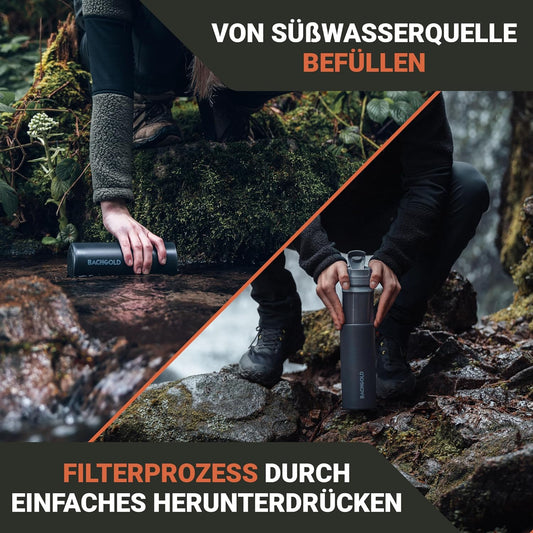
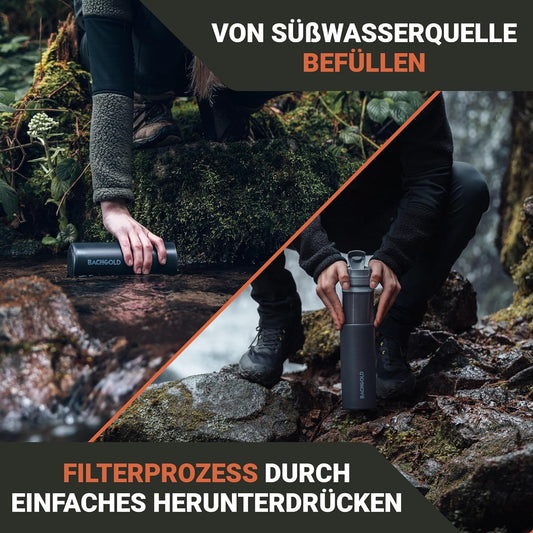
Bachgold® hollow fibre filters use a 0.2 µm membrane, so they remove larger microplastics through the same size-exclusion process described above. As with other hollow fibre filters, their effectiveness depends on the size of the particles. They are well suited for reducing larger microplastics in tap water, travel water, and emergency water supplies without requiring electricity or plumbing.
Key Takeaway
Hollow fibre filters are an effective, portable, and power-free way to reduce larger microplastics in drinking water. However, they are not designed to remove every plastic particle, particularly the smallest nanoplastics.
Can You Remove Microplastics Without a Filter? Does Boiling Work?
While boiling can reduce microplastics, it is not a reliable replacement for filtration. This is because boiling is mainly a disinfection method.
The World Health Organization (WHO) recommends bringing water to a rolling boil to inactivate bacteria, viruses, and protozoa. On its own, though, boiling does not remove chemicals, heavy metals, or plastic particles.
One notable exception comes from a 2024 study published in Environmental Science & Technology Letters. Researchers found that boiling hard tap water and then pouring it through a simple filter removed up to around 90% of microplastics and nanoplastics. As the water boils, calcium carbonate (limescale) forms and traps the plastic particles, which are then filtered out.
The results, however, depend on water hardness. In soft water, the effect was much weaker, with removal closer to 34%.
How Bachgold® Water Filters Reduce Microplastics
Bachgold® is built on a simple idea that anyone should be able to drink clean water anywhere without tablets, pumps or power. Our filters can remove microplastics larger than their 0.2 µm membrane pores.
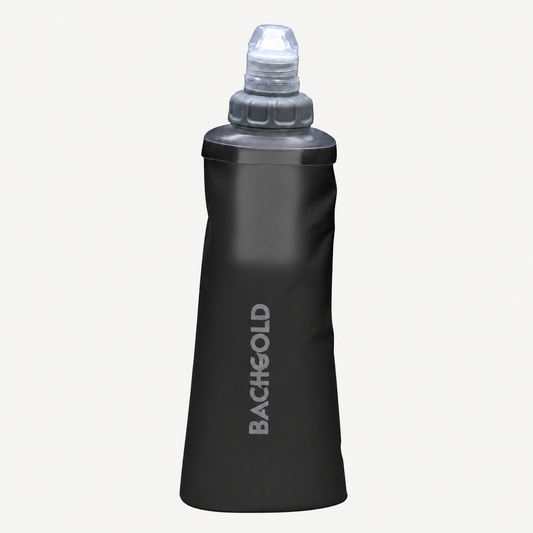
We had our Bach Gold® filters tested by independent laboratories according to the NSF P231 testing protocol, and they fulfilled the corresponding requirements. In that testing, the Bach Gold® Selfpress achieved a LOG 8 reduction of E. coli, equivalent to a 99.999999% reduction.
NSF P231 measures microbiological performance rather than microplastic removal, but it shows you how effectively the 0.2 µm membrane traps particles at that scale, and most microplastics in drinking water are far larger than 0.2 µm.
We are honest about the limit. The smallest nanoplastics can be finer than the pores and may slip through, so like every hollow fibre filter, Bach Gold® is built to reduce larger microplastics rather than remove every particle.
Reverse osmosis or nanofiltration works better for the finest nanoplastics at home, but for hiking, travel and emergency preparedness, we give you a practical way to reduce larger microplastics while protecting against bacteria and protozoa in untreated freshwater.
Explore Bachgold® filters →