You've hiked all morning to reach this ridge, and the stream running through it looks perfect. Cold and clear, straight off the mountain. However, clear doesn't mean clean.
The WHO ranks contaminated water among the leading causes of preventable illness worldwide, and most of the time, you won't see, smell, or taste the reason why. A filter is how you drink from that stream safely.
This guide covers how outdoor water filters work, what each type is suited for, and how to choose the right one for your trip.
How Much Water Do You Need While Hiking?
A 2020 study tracked hikers on a mountain trail in 40°C heat. The route took under two hours, yet most hikers fell short on water by about 750 mL each. 83% did not drink enough to replace their sweat loss, and by the next morning, 75% were clinically dehydrated. The problem was not discipline. In the heat, they simply did not bring enough to begin with.
Here is what you actually need:
-
Mild day, moderate effort: 2 to 3 L.
-
Hot day, climbing terrain: 4 to 5 L.
-
Desert or high altitude in summer: 6 to 8 L.
-
Active pace: roughly 0.5 L per hour as a baseline, more in heat.
A filter does not replace what you carry, but it does give you a safe refill option when you find a stream.
What is a Water Filter?
A water filter is a small, portable device that makes water from natural sources safe to drink without chemicals or boiling. Fill it from a stream, lake, or spring, and the filter strains out the stuff that would make you sick.
Most outdoor water filters use a hollow fibre membrane, with microscopic pores that physically block bacteria, parasites, and microplastics while letting clean water through.
What are the Different Types of Water Filters?
| Type |
Weight |
Speed |
Maintenance |
Best For |
| Squeeze Filter |
Light |
Fast |
Low |
Solo hikers |
| Self-Press Filter |
Medium |
Fast |
Low |
Backpacking & travel |
| Straw Filter |
Very Light |
Fast |
Low |
Emergency backup |
Each filter type hits that balance differently. Weight, speed, and how much fuss you want at the stream.
1. Squeeze Filters
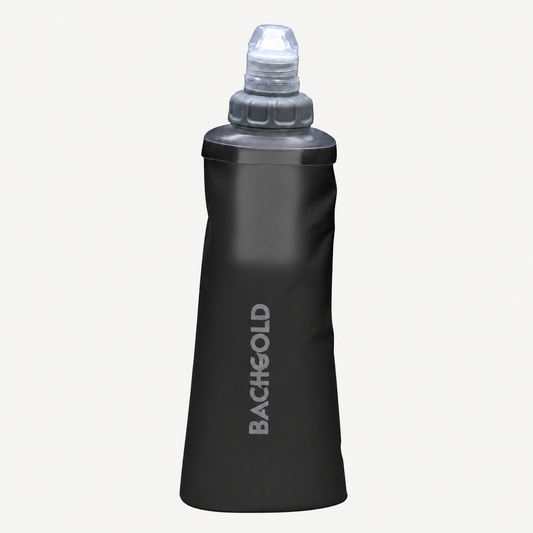
The most versatile option for solo hiking. Fill the soft pouch from a stream or lake, screw the filter onto the pouch, and squeeze the water through it into your bottle or straight into your mouth. It works with any container, packs down small, and doesn't add much to your load. If you want something simple that just works, the Bachgold® squeeze filter is worth a look.
2. Self-Press Filters
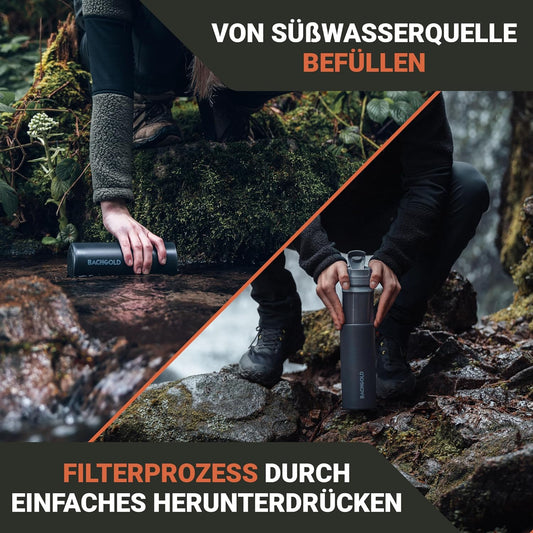
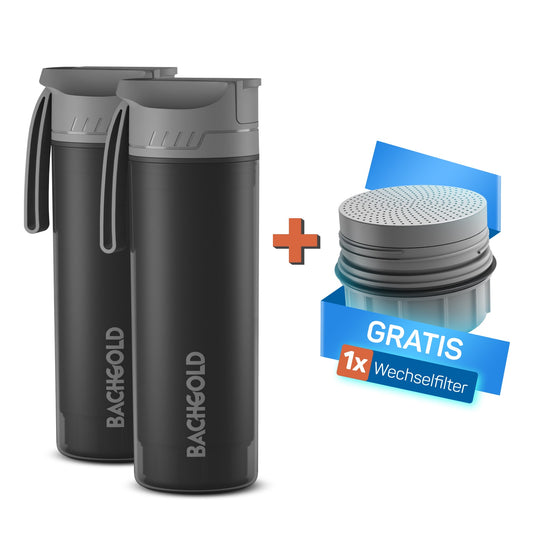
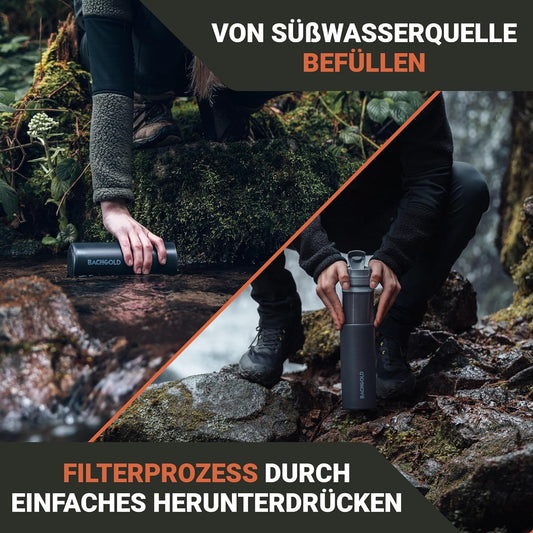
A self-press filter, like the Bachgold® press filter, builds everything into one container. There's no separate pouch, no extra parts, and nothing to assemble at the stream. You fill it, press, and drink, which makes it the obvious pick when you want filtered water without one more thing to think about.
3. Straw Filters
Straw filters are the lightest option here, light enough that you’ll forget it’s in your pack. Drink straight from any source with no bottle, no squeezing, and no wait. The trade-off is that you can't store water for later, which makes it best as a backup rather than a primary filter. The Bachgold® straw filter is compact enough to live in a side pocket permanently, there when you need it and out of the way when you don't.
Which outdoor water filter is right for you?
Explore Squeeze, Selfpress, and Straw filters to find the right solution for your next adventure.
Explore Now →
How Does a Water Filter Work While Backpacking or Hiking?
A water filter works in a simple way. Say you're on a trail and come across a clear running stream, but aren't sure if it's safe to drink. Fill your bottle from the source, push the water through the filter, and what comes out the other side is clean. Some also include an activated carbon layer that handles any taste or odor from the source.
How to Choose the Right Water Filter for Your Trip
Picking a filter is easier than you think. You can follow these four practical tips:
1. Go Compact for Day Hikes, Prioritise Flow for Multi-Day
A day hike or weekend out doesn't demand much from a filter. Any compact option will do. But if you're out for several days and filling up at streams a few times a day, you'll want one that flows fast and clears easily when it slows down. The longer the trip, the more the small inconveniences add up.
2. Size Up If You're Filtering for a Group
Solo hikers and pairs can get by with a squeeze or self-press filter. Groups need more volume, and filtering one bottle at a time for four people gets tedious fast. It is a lot easier if each person just carries their own.
3. Check Whether You Need Virus Coverage
All hollow fibre filters remove bacteria and protozoa. But if you want one that handles viruses too, you'll need to be a bit more selective. For destinations where viral contamination is a higher concern, the Bachgold® Squeeze and Straw are highly effective against viruses. For the press filter, pairing with chlorine dioxide tablets fills the gap.
4. Go Squeeze or Straw If Weight Is Your Priority
If every gram counts, a squeeze or straw filter is as light as it gets. If you'll trade a little weight for convenience, a press filter keeps everything in one bottle with nothing extra to carry.
How To Maintain a Water Filter After a Backpacking Trip?
A filter that worked fine all weekend can still let you down on your next trip if you put it away dirty. A few minutes after each trip is all it takes.
-
Backflush before you pack it away: Push clean water back through the membrane in reverse to flush out any trapped sediment. Don't skip this after a trip with murky sources.
-
Let it dry completely: A damp filter stored in a bag grows mould and degrades the membrane over time. Leave it to air dry fully before it goes back in the pack.
-
Store it away from cold: Don't leave it in an unheated garage or car over winter. A membrane that freezes while damp can crack permanently with no visible sign of damage.
-
Check the flow rate before your next trip: Give it a quick test before heading out again. If the flow doesn't recover after backflushing, it's time to replace it.
Do that, and it's ready every time you need it.
Drink Anywhere Your Feet Take You
By now, you know what's actually in that water, which filter suits your trip, and how to look after it. If your feet get you there, your filter gets you a drink.
Bachgold® filters remove bacteria and protozoa, and the Squeeze and Straw are highly effective against viruses, too. No chemicals, no batteries, and built to work wherever you find water. Part of every purchase goes into the Viva con Agua Nepal drinking-water project for the same reason, and the full range is on the product page.
Shop Bachgold® water filter today!