You might think that with a good water filter in your pack, you can safely drink from almost any water source you come across on a hike or outdoor trip. It's an easy assumption to make, and for most of the water you'll actually encounter in the backcountry, it's largely true.
But every filter has its limits. Some water sources, such as seawater, are beyond what portable water filters can treat and cannot be made safe to drink.
The good news is that you're unlikely to encounter these kinds of water while hiking. Most of the time, you'll find a clear stream or freshwater lake, which is exactly what a portable water filter is made for. The key is knowing how to tell the difference.
What Can a Water Filter Remove?
A good filter removes the bacteria and protozoa commonly found in untreated water, such as Giardia and E. coli. These germs are invisible to the naked eye and can cause illnesses, such as cramps, diarrhoea, and other issues that can quickly cut a hiking trip short.
But bacteria and protozoa aren't the only contaminants a portable water filter is built to deal with. Here's what a good filter removes:
| Contaminant |
Can a typical water filter remove it? |
| Bacteria (E. coli, Salmonella) |
Yes |
| Protozoa (Giardia) |
Yes |
| Sediment and cloudy particles |
Yes |
| Microplastics |
Yes |
Many water filters remove these contaminants instantly, with no chemicals or waiting time required. Some, however, offer an extra layer of protection.
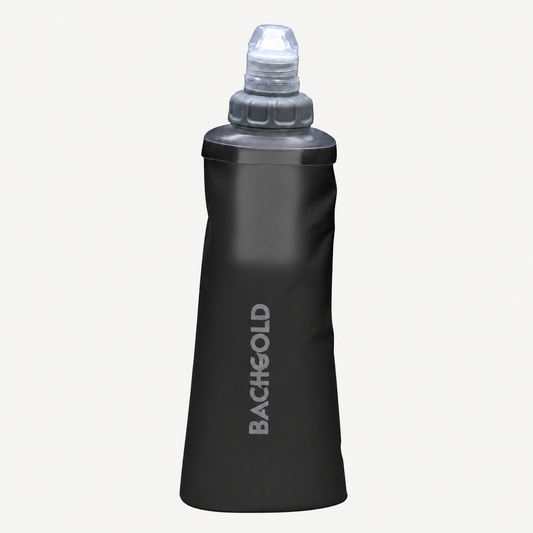
The Bachgold® Squeeze and Straw filters are highly effective against viruses, which many portable filters cannot remove. This added protection can be particularly valuable when travelling where safe water sources are less reliable.
What Can't a Water Filter Remove?
Some contaminants simply cannot be removed by a water filter, such as:
| Contaminant |
Can a typical water filter remove it? |
| Viruses (Norovirus, Hepatitis A) |
Usually no |
| Chlorine, taste and odour |
Partly |
| Dissolved chemicals, pesticides, fuel |
No |
| Heavy metals (lead, arsenic) |
No |
| PFAS |
No |
| Nitrate and fluoride |
No |
| Salt (seawater) |
No |
The rule of thumb is simple. If the contaminant is a particle or a living organism, a filter can usually catch it. If it has dissolved in the water, such as pesticides or heavy metals, you cannot treat it with a standard portable filter.
Why Can't a Water Filter Be Used on Seawater?
We cannot use a water filter on seawater because of salt. Unlike bacteria and sediment, salt is dissolved into the water itself and slips straight through. It is one of the things a filter cannot take out, and it is what makes seawater unsafe to drink.
Making seawater drinkable requires desalination, a process designed specifically to separate salt from water. The only method that manages it is reverse osmosis, which some boats carry for long ocean voyages. A standard water filter is not built for this, so no standard hiking filter can turn seawater into safe drinking water.
Tips For You
If you are hiking near the sea with a filter on you, look for a freshwater source instead, and avoid drinking seawater or running it through your filter.
Can You Filter Floodwater?
Floodwater is not a safe water source because it can contain a wide range of harmful contaminants. Along with bacteria and other disease-causing microorganisms, it often carries sewage, chemicals, fuel and industrial waste.
The CDC warns that eating or drinking anything contaminated by floodwater can cause diarrhoeal illness, such as E. coli or Salmonella, and advises staying away from it altogether. Even with a filter, you can't make floodwater safe to drink because filtering can't remove the dissolved chemicals it carries.
If flooding has affected your water supply, don't rely on a filter alone. Instead, use bottled water, boil water from a safe source when appropriate, or drink water that local authorities have confirmed is safe.
Which Water Sources Are Usually Safe to Filter?
Freshwater sources are the usual safe bet. Here are the ones you will find in nature that are safest to filter:
| Water Source |
Safe to filter? |
| Rivers and streams |
Yes |
| Lakes and ponds |
Yes |
| Collected rainwater |
Yes |
That said, there are still a few situations that call for caution. Water downstream of people or livestock may carry viruses a standard filter won't catch, farm runoff brings dissolved chemicals filtration can't remove, and any water with green scum or blue-green algae is best left alone, since those toxins survive both filtering and boiling.
The simplest test is to see what surrounds it. If there is nothing nearby that could taint the source, such as people, livestock, industry or volcanic activity, the water is almost certainly safe to drink once it has passed through a filter. Keep in mind that clear water is not automatically safe, and cloudy water is not always dangerous.
How Do You Make Water Safe to Drink?
Different water sources require different treatment methods. Here's how you can make water safer to drink in each situation:
1. Start With the Cleanest Source
Pick the best water you can. Clear flowing freshwater, properly collected rainwater, or stored emergency water is always a better choice than muddy, stagnant, or floodwater. If you've found a clean freshwater source, filtering it is usually all you need before drinking. If the water is cloudy or you're unsure about its quality, move on to the next step.
2. Clear Out the Sediment
If the water is cloudy, let it settle first, then strain the clearer water through a cloth or coffee filter before it reaches your filter. Clearing out the grit first means better flow and a longer service life.
3. Deal With Viruses
Most filters don't stop viruses, so the water may still need a second step after filtering. According to the CDC, boiling is the best way to kill germs in water, though purification tablets or a UV pen work too.
4. Steer Clear of Suspicious Water
Know when to avoid a water source altogether. Chemicals, heavy metals, salt, and industrial pollutants require reverse osmosis or distillation, which you might not have on the trail.
If the water smells of fuel, shows signs of chemical contamination, or is near industry, mining, or a spill, don't try to treat it. Walk away and find bottled water, stored emergency water, or another source you can trust.
Using a Hollow Fibre Filter on the Trail
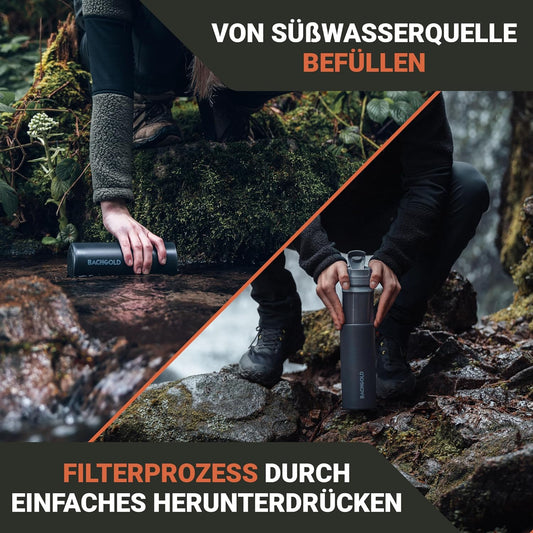
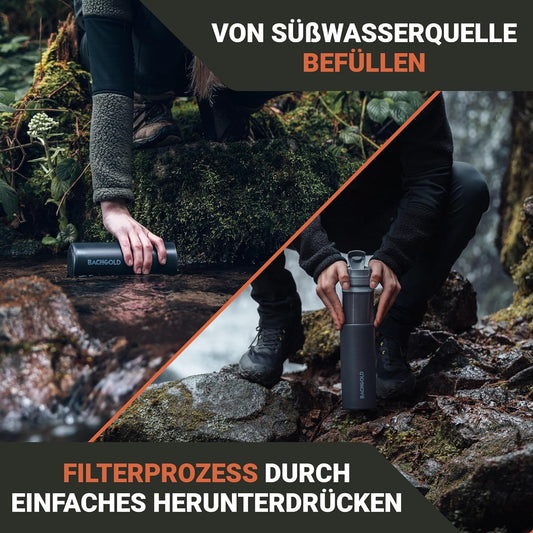
When it comes to drinking straight from a wild source, a hollow fibre filter is one of the most reliable options. Dip it in a running stream, a clear pond, or any water that looks clean, and you can drink on the spot.
Inside the filter sit thousands of tiny hollow fibres with walls full of microscopic holes. Water slips through while the bacteria, protozoa and sediment stay trapped on the outside, so what comes out the other end is clean, drinkable water.
So, Can a Filter Make Any Water Safe?
Not quite, and now you know where the line sits. The clear streams and ponds out on the trail are yours for the taking, while seawater, floodwater and chemical-tainted water are the ones to walk past. The rest comes down to having the right filter when you reach the water.
All Bachgold® water filters are effective against bacteria and protozoa, while the Squeeze and Straw are also highly effective against viruses. They require no chemicals or batteries. Explore the full range on the product page.
For every purchase, some of our revenue goes into the Viva con Agua Nepal drinking-water project, helping bring cleaner water to people who do not have a filter to reach for.
Shop the Bachgold® filter today!